Showing posts with label half integer quadrupoles. Show all posts

Tuesday, June 22, 2010

Solid State NMR of Half Integer Quadrupolar Nuclei

Many students who do liquid state NMR or solid state NMR of spin I=1/2 nuclei have very little appreciation for the information content and complexity of the solid state NMR spectra of spin I = n/2 quadrupolar nuclei (n= 3, 5, 7....). In part, I think this may be due to the mathematics involved with explaining the important effects. With this post, I attempt to describe the NMR spectrum of an I = 5/2 nucleus in the soild state without resorting to mathematics. I hope that this post helps to boost the understanding and appreciation for the NMR spectra of these important nuclei.

When one collects the NMR spectrum a spin I = n/2 nucleus in solution, one normally observes a single NMR resonance line for each species as the (n+1) Zeeman energy levels are equally spaced and the nucleus is undergoing fast isotropic motion. The width of the resonance depends upon the efficiency of the relaxation (usually dominated by the quadrupolar interaction). The more efficient the relaxation, the broader the resonance. In many cases, the width of the resonance may be comparable to the complete chemical shift range for the nucleus and in some cases it may be so broad as to make its observation impractical or impossible. For these reasons I = n/2 quadrupolar nuclei generate less than their share of interest in liquid state NMR compared to spin I = 1/2 nuclei like 1H, 13C, 31P ..... etc.

In the solid state, the situation is much different as there is rarely fast isotropic motion. When the quadrupolar interaction is much less than the Zeeman interaction, the Zeeman energy level diagram is affected by both a first order and a second order quadrupolar perturbation as shown in the figure below for an I = 5/2 nucleus. The second order perturbation is much smaller than the first order.The energy levels are no longer equally spaced. Furthermore, the position of the resonances resulting from the transitions depends on the orientation of the nucleus with respect to the magnetic field. Since all orientations are represented equally in a powder sample, each transition gives a powder spectrum. This is illustrated on the right-hand side of the figure. Note that the m = 1/2 and m = -1/2 energy levels are affected equally to first order and that the central (m = 1/2 - m = -1/2) transition is affected only by the second order perturbation. As a result the line width of the resonance from the central transition is much narrower than the other transitions. (In the figure, the central transition is clipped significantly.). Unlike the first order interaction, the second order interaction is field dependent. The width of the central transition depends inversely on the strength of the magnetic field.

Magic angle spinning is a technique used by solid state NMR spectroscopists to obtain high resolution NMR spectra of solids. Magic angle spinning at infinite speed completely averages the first order quadrupolar interaction but only partially averages out the second order interaction. The energy level diagram for a spin I = 5/2 nucleus spinning infinately fast at the magic angle is shown in the figure below along with a simulated spectrum. The spectrum consists of a central transition, CT, and two satellite transitions, ST1 and ST2. Note that along with a lineshape due to the orientational dependence of the nucleus in the magnetic field, there is also an isotropic quadrupolar shift. The central and satallite transitions are not at the same frequency. This effect is completely separate from the chemical shift.
In practice, we cannot spin at infinite speed, however, we can often spin at a rate fast with respect to the width of the central transition. If the quadrupolar coupling constant is small enough, the central transition will be observed and affected only by the second order interaction. The satellite transitions, affected by both the first and second order interaction, are observed as a manifold of spinning sidebands. The intensity of the centerbands for the satellite transitions is greatly attenuated as the overall intensity is spread among all of the sidebands. Often the centerbands for the satellite transitions are so small in comparison to that of the central transition that they are not observed. This is illustrated with simulations in the lower portion of the figure below. For comparison, the upper portion shows similar simulated spectra without magic angle spinning. The spectra highlighted in yellow are expansions of the central portion of the spectrum. These simulations are also supported by observations.

Monday, November 24, 2008

90 Degree Pulses for I = n/2 Quadrupolar Nuclei in the Solid State

The 90 degree pulse for an I = n/2 quadrupolar nucleus in the solid state depends on the strength of the rf pulse with respect to the quadrupolar frequency. If the strength of the pulse is much greater than the quadrupolar frequency, the pulse is non-selective and excites all transitions equally. If however it is much less than the quadrupolar frequency, then the pulse is selective to the central (m = 1/2 - m = -1/2) transition. The duration of the pulse producing a maximum signal is shorter for selective vs. non-selective pulses at a similar power level. In solution, where the quadrupolar interactions is averaged by random isotropic molecular motion or in the solid state, if the symmetry around the I = n/2 nucleus is cubic, the quadrupolar frequency is small with respect to the strength of the rf pulses and the pulses are non-selective. When the symmetry around the I = n/2 nucleus in the solid state is non-cubic, the quadrupolar frequency is significant and the pulses are very often selective to the central transition. This is illustrated in the figures below for the 23Na MAS spectrum of a mixture of NaCl (cubic) and Na2SO4 (non-cubic). The first figure shows the 23Na MAS spectrum labelling each component of the mixture. The second figure shows the effect of increasing the pulse duration. One can clearly see that the 90 degree pulse for NaCl is close to twice that of Na2SO4.

Friday, August 22, 2008

The Fourier Transform of a Single Rotational Echo

The spinning sidebands in MAS NMR spectra are the result of rotational echos in the free induction decay. These echos show up as spikes in the free induction decay (and can be used conveniently to set the magic angle). The intensity envelope of the spinning sideband manifold in the NMR spectrum mimics the static wideline spectrum. One can obtain an NMR spectrum similar to the wideline spectrum from MAS data by Fourier transforming a single rotational echo rather than the entire FID. This is illustrated in the figure below for the 27Al MAS data for kaolinite at 21.1 Tesla.

Wednesday, May 28, 2008

Using the Nyquist Sampling Theorem to Obtain Higher Resolution Solid State NMR Spectra of Spin I = n/2 Quadrupolar Nuclei.

In favorable circumstances, the solid state MAS NMR spectra of spin I = n/2 quadrupolar nuclei can show a strong central transition (free of spinning sidebands) and the satellite transitions in an extended spinning sideband manifold. Although the central transition is very strong, it is often broadened out significantly by the second order quadrupolar interaction. This broadening often presents resolution problems when more than one site is present. The problem can of course be reduced by going to higher magnetic field strengths where the second order interaction is reduced. If this option is not available, it is sometimes advantageous to look at the satellite transitions which can be affected to a lesser extent by the second order quadrupolar interaction and therefore exhibit narrower lines. Such is the case for the first satellite transition for 27Al. The problem is that since the satellite transitions are spread over a very large sideband manifold, any one sideband is of very low intensity. It is desirable to add the intensities of all of the sidebands into the 0th order sideband. This is conveniently accomplished by taking advantage of the Nyquist sampling theorem and collecting the data in simultaneous mode without digital filtering. If the dwell time is made equal to a single rotor period (i.e. the spectral width is set to one half of the spinning speed) and the analog filter bandwidth is maximized, the sidebands of the satellite transitions will all fold into the 0th. order sideband. If the magic angle is set very precisely, in the case of the first satellite transition of 27Al, the intensity of this sharper line is greater than that of the central transition. Further, the central transition can be suppressed with a double quantum filter (Ashbrook and Wimperis, Journal of Magnetic Resonance, 177, 44 (2006)) to produce a clean spectrum with a much sharper line than the central transition. This is illustrated for the 27Al MAS NMR spectrum of Al(acac)3 in the figure below.

Wednesday, April 23, 2008

Satellite Transitions in the Solid State NMR Spectra of Spin I= 5/2 Nuclei

The solid state MAS NMR spectra of spin I = n/2 (n = 1, 3, 5 ....) quadrupolar nuclei are more complicated than many people realize. There are chemical shielding anisotropy effects and both first order and second order quadrupolar effects which must be taken into account. Magic angle spinning averages out the first order quadrupolar effects and the chemical shielding anisotropy however, these interactions may show up as spinning sidebands. The field dependant second order quadrupolar effects are only partially averaged by magic angle spinning. In an MAS spectrum, each transition of the spin I = n/2 nucleus will have both a frequency shift and line shape characterized by the partially averaged second order quadrupolar interaction. The frequency shifts and lineshapes can provide valuable information about the quadrupolar coupling constant and the asymmetry parameter. The figure below shows the centerband region of the 27Al (I = 5/2) MAS NMR spectrum of aluminum-tris-acetylacetonate (Al(acac)3) acquired at 11.75 Tesla. There is only one aluminium site in the asymmetric unit of this compound. The major component of the spectrum is the central transition (m=1/2 - m= -1/2). It is the most intense as it is unaffected by the first order quadrupolar interaction and therefore does not have its intensity spread over multiple spinning sidebands. The first satellite transitions (m=3/2 - m= 1/2 and m= -1/2 - m= -3/2) are affected equally by the second order quadrupolar interaction and appear as a narrow resonance to higher frequency than the central transition. The second satellite transitions (m=5/2 - m= 3/2 and m= -3/2 - m= -5/2) are also affected equally by the second order quadrupolar interaction and appear as a weak broad resonance to higher frequency than both the first satellite transition and the central transition. Both satellite transitions are weak as their intensity is spread over many spinning sidebands (not shown). The second satellite transition is weaker than the first as it has a much broader line shape.

Tuesday, April 8, 2008

The Field Dependence of the Second Order Quadrupolar Interaction in Solids

Most of the NMR active isotopes in the periodic table are quadrupolar, so it is understandable that there is a great deal of interest in obtaining NMR data for quadrupolar nuclei. In the solid state, one typically observes the central transition for spin I = n/2 nuclei. This transition is unaffected by the first order quadrupolar interaction however it is affected by the second order quadrupolar interaction. Magic angle spinning only partially averages the second order quadrupolar interaction and as a result one observes a broadened resonance of the central transition in MAS spectra. In favorable circumstances, the shape of this resonance can be used get information about the quadrupolar coupling and chemical shift tensors. The second order quadrupolar interaction is inversely proportional to the strength of the magnetic field so narrower lines (and therefore higher resolution) are obtained at higher field strengths. This accounts for all of the interest in ultrahigh-field NMR facilities for solids such as the one in Ottawa. The figure below shows the 27Al (I = 5/2) MAS spectrum of kaolinite obtained at three different field strengths, plotted on the same chemical shift scale. In addition to the narrowing of the resonance at higher fields, note that the "center of gravity" of the resonance also shifts with field. The "center of gravity" of the resonance approaches the true chemical shift only in the high field limit and therefore should not be reported in the literature as a "chemical shift".

Friday, February 15, 2008

Setting the Magic Angle

High resolution solid state NMR employs a technique called "Magic Angle Spinning" where the sample is spun at an angle of 54.736 degrees with respect to the magnetic field at a rate fast with respect to the interactions being averaged. In order to achieve high resolution, the angle must be set very precisely. This is commonly done by looking at the 79Br signal of KBr. The intensity of the spinning sidebands for the satellite transition of the I = 3/2 79Br is strongly related to the precision of the magic angle. The sidebands appear as rotational echos in the 79Br FID. The more rotational echoes - the stronger the sidebands and therefore the more precise the angle setting. Although any quadrupolar isotope with strong satellite transition sidebands can be used for this purpose, the 79Br of KBr is particularly convenient as the resonance is very close to 13C, has a short T1, and can be seen easily in one scan. The spectrometer is set up to scan without adding the signals and the angle adjustment is made while observing the FID until a maximum number or rotational echos is observed.

Thursday, November 22, 2007

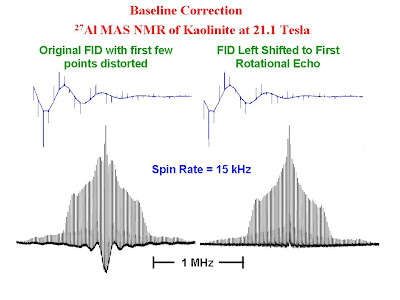
Baseline Correction in Satellite Transition MAS Spectra of Quadrupolar Nuclei

When one acquires NMR data with extremely short dwell times (or very large spectral widths), problems are often encountered with severe baseline roll as the first few points in the FID are lost either to the receiver dead time or probe ringing. The satellite transition MAS spectra of quadrupolar nuclei are characterized by many sharp spinning sidebands and require the use of very large spectral widths to accommodate the entire sideband envelope. The FIDs for such samples contain rotational echoes at the period of the rotor. Due to the extremely short dwell times required to collect such data, baseline problems are very common. In such cases simply removing the initial few bad points or using backward linear prediction will not solve the problem satisfactorily due to the nature of the FID. There is however a very simple solution. One can simply remove all of the points in the FID before the first rotational echo and then carry out the Fourier transform. The figure below shows the FID's and spectra for the 27Al MAS NMR of kaolinite. The spectra show the satellite transitions. The resonance for the central transition is off scale in the figure. In the left hand side of the figure the raw FID was Fourier transformed and phase corrected. One can see extreme baseline roll. In the right hand side of the figure, all of the points prior to the center of the first rotational echo in the FID were discarded and the new FID was Fourier transformed and phase corrected. The baseline is much improved.