
Showing posts with label baseline correction. Show all posts
Showing posts with label baseline correction. Show all posts
Friday, September 12, 2008
Baseline Correction in 2D NMR Spectra
Sometimes a 1D NMR spectrum will have a baseline roll. One way of correcting this is to fit the baseline of the spectrum (between two limits) to a polynomial and then subtract the polynomial from the spectrum to produce a flat baseline. Baseline roll is not an exclusive problem to 1D data. It can also be present in each domain of a 2D data set. Baseline orrection can be applied to each of the dimensions. The figure below shows a proton NOESY spectrum which is uncorrected (top left), baseline corrected in the rows (top right), baseline corrected in the columns (bottom left) and baseline corrected in both domains (bottom right).


Thursday, December 20, 2007
Improving Your Baseline Correction
Spectral baselines are often corrected in Bruker's software by using the "abs" command after Fourier transformation. This correction is not always well suited to the data. Another method of getting flatter baselines is to define specific frequency limits "absf1" and "absf2" over which the baseline will be corrected and then use the "absf" command rather than the "abs" command. The smaller the difference between "absf1" and "absf2", the better the correction will be. Below is an example where "absf1" and "absf2" are defined by the region in pink.
Thursday, November 22, 2007
Baseline Correction in Satellite Transition MAS Spectra of Quadrupolar Nuclei
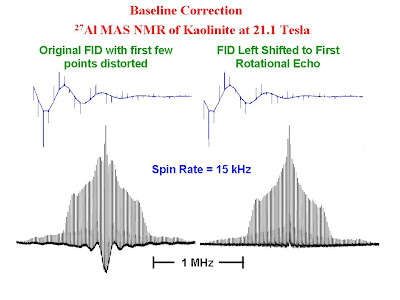
When one acquires NMR data with extremely short dwell times (or very large spectral widths), problems are often encountered with severe baseline roll as the first few points in the FID are lost either to the receiver dead time or probe ringing. The satellite transition MAS spectra of quadrupolar nuclei are characterized by many sharp spinning sidebands and require the use of very large spectral widths to accommodate the entire sideband envelope. The FIDs for such samples contain rotational echoes at the period of the rotor. Due to the extremely short dwell times required to collect such data, baseline problems are very common. In such cases simply removing the initial few bad points or using backward linear prediction will not solve the problem satisfactorily due to the nature of the FID. There is however a very simple solution. One can simply remove all of the points in the FID before the first rotational echo and then carry out the Fourier transform. The figure below shows the FID's and spectra for the 27Al MAS NMR of kaolinite. The spectra show the satellite transitions. The resonance for the central transition is off scale in the figure. In the left hand side of the figure the raw FID was Fourier transformed and phase corrected. One can see extreme baseline roll. In the right hand side of the figure, all of the points prior to the center of the first rotational echo in the FID were discarded and the new FID was Fourier transformed and phase corrected. The baseline is much improved.
Subscribe to:
Posts (Atom)
