
Showing posts with label Pure-Shift. Show all posts
Showing posts with label Pure-Shift. Show all posts
Friday, January 3, 2020
1H J-Resolved Spectroscopy to Evaluate 1H-1H and 1H-19F Coupling Constants
2D 1H J-RESolved spectroscopy (JRES) is able to separate the 1H chemical shift and J coupling interactions in the F2 and F1 domains of the 2D data, respectively. The F2 projection represents the pure-shift 1H decoupled 1H NMR spectrum while the individual F1 slices at each chemical shift reveal the 1H - 1H J coupling for each resonance. When this technique is applied to a spin system with both homonuclear 1H-1H coupling and heteronuclear coupling, it has the ability to provide both the homonuclear and heteronuclear coupling constants. This is demonstrated in the figure below for 2,3-difluoro pyridine which has both 1H-1H and 1H-19F coupling.
 The top trace in the figure is the 1H NMR spectrum showing the complex resonances due to both the homonuclear and heteronuclear coupling. The 2D JRES spectrum is highlighted in grey. The 1H-1H coupling is shown in the F1 slices which were summed to produce the blue, red and green vertical traces in the figure for 1H resonances A, C and B, respectively. These traces are identical to the resonances in the separately collected 1H spectrum with 19F decoupling shown in the bottom trace of the figure. The F2 projection of the JRES spectrum is shown in the trace directly on top of the 2D spectrum, colour coded in yellow. The F2 projection represents the 1H decoupled 1H spectrum showing only the 1H- 19F coupling. It can be compared to the separately collected PSYCHE pure-shift 1H spectrum, colour coded in orange which is very nearly identical. Clearly this very simple, often overlooked, technique can provide a great deal of both homonuclear and heteronuclear coupling information.


Wednesday, October 31, 2018
Pure-Shift HSQC
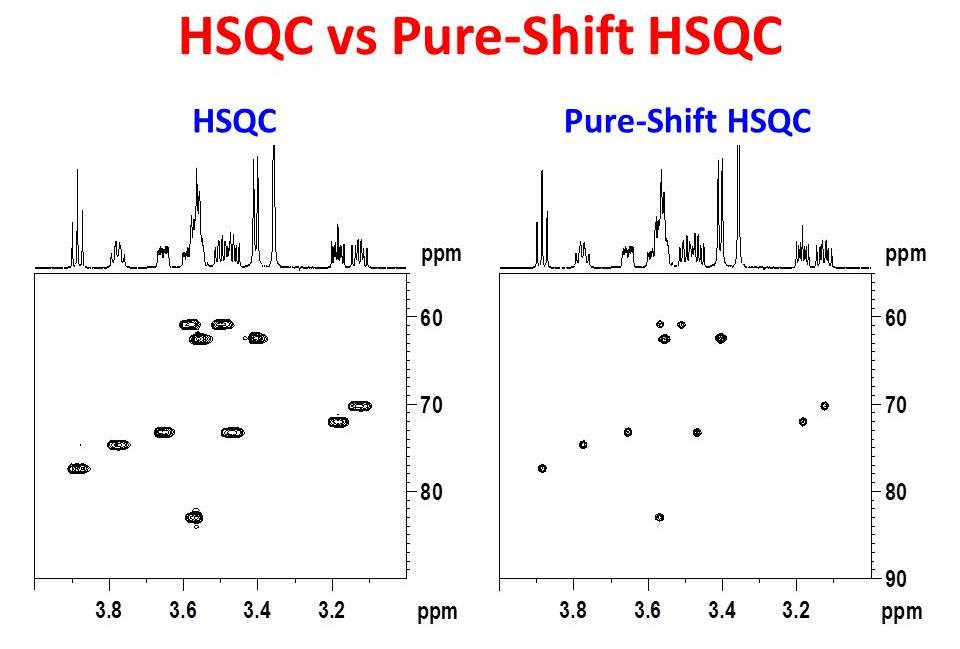
Pure-shift NMR has become more and more common over the last few years. A special issue of Magnetic Resonance in Chemistry has recently been dedicated to developments in these methods. Pure-shift NMR methods offer simplified proton NMR spectra free of 1H - 1H coupling. These methods have been extended to proton detected 2D NMR measurements, yielding 2D data sets with higher proton resolution compared to conventional 2D measurements. The NMR Methodology Group at the University of Manchester has been a primary contributor to this technique and has kindly shared their efforts on-line. The figure below compares the 600 MHz partial Pure-Shift HSQC spectrum of sucrose in DMSO-d6 to a more conventional HSQC spectrum acquired under similar conditions. The projections on the spectra are independently collected high resolution 1H NMR spectra. Clearly, the Pure-Shift HSQC data have higher 1H resolution than the more conventional HSQC. What may not be so obvious from the figure is that the sensitivity is also improved in the Pure-Shift HSQC. The gain in signal-to-noise-ratio depends strongly on the degree of coupling collapsed. For some signals in this spectrum, an improvement in the signal-to-noise-ratio as high as 72% was observed.
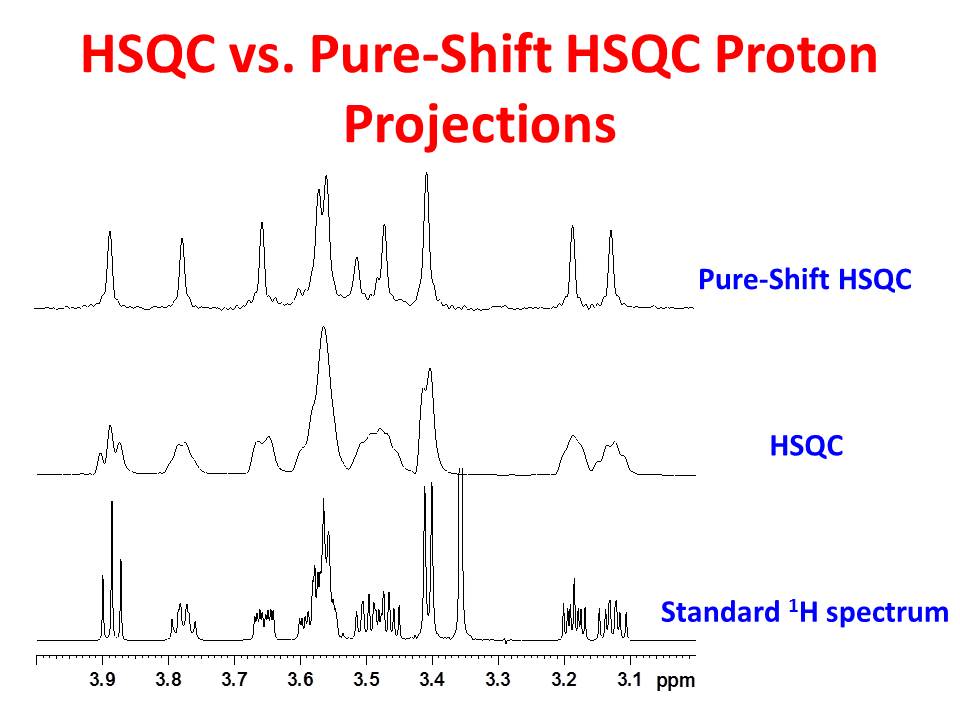
 The the top and middle panels of the figure below show the 1D 1H projections of the Pure-Shift HSQC and HSQC data from the above figure, respectively. The bottom panel is the conventional high resolution 1H spectrum for comparison.
 Clearly, the Pure-Shift HSQC proton projection offers much improved resolution.
Subscribe to:
Posts (Atom)
