
Showing posts with label satellite transitions. Show all posts
Showing posts with label satellite transitions. Show all posts
Wednesday, May 28, 2008
Using the Nyquist Sampling Theorem to Obtain Higher Resolution Solid State NMR Spectra of Spin I = n/2 Quadrupolar Nuclei.
In favorable circumstances, the solid state MAS NMR spectra of spin I = n/2 quadrupolar nuclei can show a strong central transition (free of spinning sidebands) and the satellite transitions in an extended spinning sideband manifold. Although the central transition is very strong, it is often broadened out significantly by the second order quadrupolar interaction. This broadening often presents resolution problems when more than one site is present. The problem can of course be reduced by going to higher magnetic field strengths where the second order interaction is reduced. If this option is not available, it is sometimes advantageous to look at the satellite transitions which can be affected to a lesser extent by the second order quadrupolar interaction and therefore exhibit narrower lines. Such is the case for the first satellite transition for 27Al. The problem is that since the satellite transitions are spread over a very large sideband manifold, any one sideband is of very low intensity. It is desirable to add the intensities of all of the sidebands into the 0th order sideband. This is conveniently accomplished by taking advantage of the Nyquist sampling theorem and collecting the data in simultaneous mode without digital filtering. If the dwell time is made equal to a single rotor period (i.e. the spectral width is set to one half of the spinning speed) and the analog filter bandwidth is maximized, the sidebands of the satellite transitions will all fold into the 0th. order sideband. If the magic angle is set very precisely, in the case of the first satellite transition of 27Al, the intensity of this sharper line is greater than that of the central transition. Further, the central transition can be suppressed with a double quantum filter (Ashbrook and Wimperis, Journal of Magnetic Resonance, 177, 44 (2006)) to produce a clean spectrum with a much sharper line than the central transition. This is illustrated for the 27Al MAS NMR spectrum of Al(acac)3 in the figure below.


Wednesday, April 23, 2008
Satellite Transitions in the Solid State NMR Spectra of Spin I= 5/2 Nuclei
The solid state MAS NMR spectra of spin I = n/2 (n = 1, 3, 5 ....) quadrupolar nuclei are more complicated than many people realize. There are chemical shielding anisotropy effects and both first order and second order quadrupolar effects which must be taken into account. Magic angle spinning averages out the first order quadrupolar effects and the chemical shielding anisotropy however, these interactions may show up as spinning sidebands. The field dependant second order quadrupolar effects are only partially averaged by magic angle spinning. In an MAS spectrum, each transition of the spin I = n/2 nucleus will have both a frequency shift and line shape characterized by the partially averaged second order quadrupolar interaction. The frequency shifts and lineshapes can provide valuable information about the quadrupolar coupling constant and the asymmetry parameter. The figure below shows the centerband region of the 27Al (I = 5/2) MAS NMR spectrum of aluminum-tris-acetylacetonate (Al(acac)3) acquired at 11.75 Tesla. There is only one aluminium site in the asymmetric unit of this compound. The major component of the spectrum is the central transition (m=1/2 - m= -1/2). It is the most intense as it is unaffected by the first order quadrupolar interaction and therefore does not have its intensity spread over multiple spinning sidebands. The first satellite transitions (m=3/2 - m= 1/2 and m= -1/2 - m= -3/2) are affected equally by the second order quadrupolar interaction and appear as a narrow resonance to higher frequency than the central transition. The second satellite transitions (m=5/2 - m= 3/2 and m= -3/2 - m= -5/2) are also affected equally by the second order quadrupolar interaction and appear as a weak broad resonance to higher frequency than both the first satellite transition and the central transition. Both satellite transitions are weak as their intensity is spread over many spinning sidebands (not shown). The second satellite transition is weaker than the first as it has a much broader line shape. 
Thursday, November 22, 2007
Baseline Correction in Satellite Transition MAS Spectra of Quadrupolar Nuclei
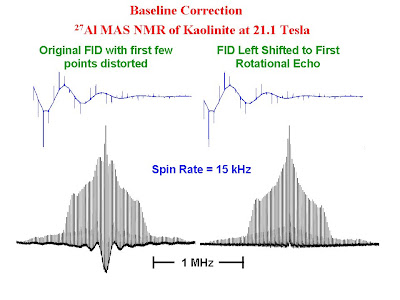
When one acquires NMR data with extremely short dwell times (or very large spectral widths), problems are often encountered with severe baseline roll as the first few points in the FID are lost either to the receiver dead time or probe ringing. The satellite transition MAS spectra of quadrupolar nuclei are characterized by many sharp spinning sidebands and require the use of very large spectral widths to accommodate the entire sideband envelope. The FIDs for such samples contain rotational echoes at the period of the rotor. Due to the extremely short dwell times required to collect such data, baseline problems are very common. In such cases simply removing the initial few bad points or using backward linear prediction will not solve the problem satisfactorily due to the nature of the FID. There is however a very simple solution. One can simply remove all of the points in the FID before the first rotational echo and then carry out the Fourier transform. The figure below shows the FID's and spectra for the 27Al MAS NMR of kaolinite. The spectra show the satellite transitions. The resonance for the central transition is off scale in the figure. In the left hand side of the figure the raw FID was Fourier transformed and phase corrected. One can see extreme baseline roll. In the right hand side of the figure, all of the points prior to the center of the first rotational echo in the FID were discarded and the new FID was Fourier transformed and phase corrected. The baseline is much improved.
Subscribe to:
Posts (Atom)
