
Showing posts with label Christmas. Show all posts
Showing posts with label Christmas. Show all posts
Friday, December 7, 2018
NMR and the Taste of Christmas - Gingerbread
The holiday season is full of delicious treats. Aside from rum spiked eggnog, candy canes, fruitcake, shortbread and cranberry sauce, one of my favorite Christmas treats is gingerbread. Whether you enjoy biting the limbs off a gingerbread man or munching on the roof of a gingerbread house, you cannot escape the wonderful aroma and flavor of ginger and cinnamon. These fragrant spices can be easily examined by NMR spectroscopy. The figure below shows the 600 MHz 1H NMR spectra of CDCl3 extracts of ground ginger (top) and ground cinnamon (bottom).
 The main constituents of these extracts are 6-gingerol and cinnamaldehyde for the ginger and cinnamon extracts, respectively. Think of these compounds and their NMR spectra while you bite the head off your next gingerbread man in front of your beautifully decorated Christmas tree. Merry Christmas!


Monday, December 11, 2017
NMR of Cranberries. Why Are They So Sour?
Arguably, one of the highlights of the Christmas season is a delicious turkey dinner. The most common condiment for the turkey is a tart, mouth watering cranberry sauce. Have you ever wondered why cranberries are so sour? The sour taste comes from organic acids. These can easily be detected in the 1H and 13C NMR spectra of cranberries. The figure below shows the 1H and 13C NMR spectra of a D2O extract of crushed fresh cranberries.
 Malic acid, citric acid, quinic acid and benzoic acid can easily be identified in the spectra. These account for the sour taste. Glucose, fructose and sucrose can also be identified however, the taste is dominated by the acids. There are of course many other compounds present in cranberries at much lower concentrations than the acids and sugars. Many of these account for the brilliant red color and antioxidant properties of this delicious healthy berry. Enjoy your Christmas turkey accompanied by tasty, tart, cranberries!

Monday, December 21, 2015
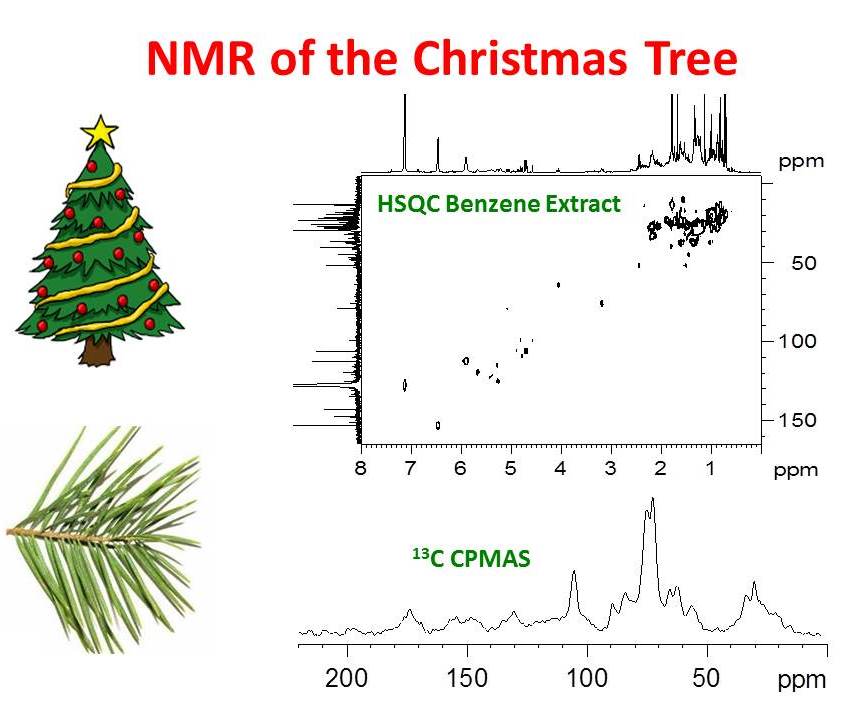
NMR of the Christmas Tree
One of my fondest memories as a child is the colorful lights and especially the smell of a decorated Christmas tree. The hot incandescent lights used years ago would heat up the tree evaporating the fragrant compounds in the needles producing the very memorable and wonderful smell of Christmas. Although modern artificial Christmas trees and cool LED lights have made the holiday season safer with respect to fires, they have taken much of the magic out of Christmas. Among many other compounds, it is pinene, bornyl acetate and citronellol that contribute to the Christmas smell of evergreen needles.
 We can use NMR spectroscopy to look for these compounds and perhaps recover a bit of the Christmas magic. The bottom panel of the figure below shows the 13C CPMAS spectrum of spruce needles. One can easily identify the signals from cellulose in the CPMAS spectrum of the needles while some of the smaller peaks can be attributed to fragrant compounds. Many of the fragrant compounds in the needles are likely to be in a liquid-like state and not cross polarize very well. These will either be absent or under-represented in the CPMAS spectrum. The top panel of the figure shows the 1H - 13C HSQC spectrum of a benzene-d6 extract prepared from crushed spruce needles. The top and left-side projections are the high resolution 1H and 13C NMR spectra, respectively. This sample is expected to contain all of the benzene soluble compounds. The spectrum is free of cellulose resonances and shows a mixture of fragrant compounds.
 These data don't recover the childhood magic of Christmas but they do bring a little bit of joy to this NMR spectroscopist.
Merry Christmas

Merry Christmas
Thursday, December 22, 2011
13C NMR of a Delicious Christmas Treat
As my Santa Claus-like belly may indicate, I love holiday treats. The solid-state 13C NMR spectra below were collected from a special sample of a holiday treat prepared by my wife, Patty from her Great Grandma Jennings lab book. The sample was prepared from only four ingredients as follows:
To 227 g of softened butter, 65 g of fructose was added while stirring with a spatula. Slowly, 199 g of flour and 1.26 g of sodium chloride were stirred into the mixture until it became difficult to mix with a spatula. The mixture was kneaded gently until cracks in the surface began to appear after which it was rolled to a thickness of 38 mm and cut into round samples of approximately 51 mm in size. The samples were heated in an oven at 436 K - 450 K for approximately 600 seconds until gold in color.
 The bottom trace is a 13C CPMAS spectrum and the top trace is a 13C MAS spectrum. Both spectra were acquired with high power 1H decoupling. This pair of spectra serves to illustrate the different types of information available from each of these techniques. The sample is a mixture of rigid and mobile components. The 13C CPMAS technique detects mainly the more rigid components as it relies on the dipolar coupling between protons and 13C for the cross polarization. The dipolar coupling is averaged to nearly zero for the mobile constituents and therefore they do not appear in the spectrum. The 13C CPMAS spectrum therefore, shows primarily all of the rigid constituents (mainly flour and sugar). The 13C MAS spectrum with high power 1H decoupling shows both rigid and mobile constituents. The resonances from the mobile constituents (mainly butter) have sharp lines while the broader lines from the rigid constituents show up at very low intensity as the sensitivity is not enhanced by cross polarization.
Now, you too have enjoyed Patty's delicious shortbread.
To 227 g of softened butter, 65 g of fructose was added while stirring with a spatula. Slowly, 199 g of flour and 1.26 g of sodium chloride were stirred into the mixture until it became difficult to mix with a spatula. The mixture was kneaded gently until cracks in the surface began to appear after which it was rolled to a thickness of 38 mm and cut into round samples of approximately 51 mm in size. The samples were heated in an oven at 436 K - 450 K for approximately 600 seconds until gold in color.
The bottom trace is a 13C CPMAS spectrum and the top trace is a 13C MAS spectrum. Both spectra were acquired with high power 1H decoupling. This pair of spectra serves to illustrate the different types of information available from each of these techniques. The sample is a mixture of rigid and mobile components. The 13C CPMAS technique detects mainly the more rigid components as it relies on the dipolar coupling between protons and 13C for the cross polarization. The dipolar coupling is averaged to nearly zero for the mobile constituents and therefore they do not appear in the spectrum. The 13C CPMAS spectrum therefore, shows primarily all of the rigid constituents (mainly flour and sugar). The 13C MAS spectrum with high power 1H decoupling shows both rigid and mobile constituents. The resonances from the mobile constituents (mainly butter) have sharp lines while the broader lines from the rigid constituents show up at very low intensity as the sensitivity is not enhanced by cross polarization.Now, you too have enjoyed Patty's delicious shortbread.
Wednesday, December 15, 2010

Monday, December 21, 2009
What is this Holiday Treat?
Things are beginning to wind down at the University of Ottawa as the end of exams approaches and we all look forward to a few holidays. I would like to wish all readers a happy and safe holiday season.
I leave you with a little puzzle. The 13C MAS NMR spectrum of one of my favorite holiday treats is shown below. What is it? Leave a comment to this post with your guess. (hint: cross polarization was attempted but was quite inefficient). 
Monday, December 22, 2008

Subscribe to:
Posts (Atom)
